
Illuminating Idaho Member Newsletter
Illuminating Idaho is the Idaho State Historical Society’s exclusive member newsletter, created just for history lovers like you. Each month, it shines a light on fascinating stories from Idaho’s past, highlights statewide historical happenings, and shares unique ways for members to get involved. It’s your inside connection to the people, places, and moments that continue to shape the Gem State.
Contact
(208) 334-2682
This Month's Illuminating Idaho
Democracy's Drying Ink: What Signatures Reveal About Authority
written by state historian hannalore hein
On the 4th of July, Americans host picnics, watch parades, view fireworks, and enjoy their communities and the country’s natural landscapes, all in celebration of the country’s founding. On that date, in 1776, delegates of the Second Continental Congress officially adopted the language of the Declaration of Independence. Then, they waited. More than two weeks later, on July 19th, the delegates resolved that the Declaration “be fairly engrossed on parchment” and “signed by every member of Congress.” The Journals of the Continental Congress recorded the signature day, and it wasn’t in July. It was August 2, 1776. The National Archives and Records Administration argues that the belief that all the delegates signed on July 4th is “one of the most widely held misconceptions” about the document.1 If this misconception has persisted throughout our country’s history, and the signatures in fact dried on the parchment in August, what other meaning can we glean from famous signatures in American and Idaho history, and what can they tell us about government practices at both the local and national level?
Most Americans can probably associate the name John Hancock with signing their own names, even if they can’t place his name as the first and largest signature on the Declaration of Independence. In 1764, at age twenty-seven, he inherited his uncle’s fortune and mercantile interests. He continued in this line of work, but by 1768, the crown seized one of his vessels, which had been smuggling wine to avoid taxation. He quickly became a traitor—and a martyr—as colonists in Massachusetts rallied around him. As discontent grew, Hancock’s patriotism and role in public resistance grew, too, paving the way for him to become a delegate and President of the Second Continental Congress in July 1776.2
After Hancock, most other delegates signed on August 2nd, but some did not add their names until the fall of 1776, and one delegate, Thomas McKean, did not sign until years later.[^3] The delegates recognized that signing the declaration, as the final sentence conveyed, was a mutual pledge to resistance, but it also, more practically, represented a signed death warrant, for if their patriot cause failed, they would surely be tried and killed for treason.
Separate that story into its real component parts and the picture sharpens. First comes debate: people argue a position until enough of them agree on its exact wording. Second comes the signature: a person or body with legal standing marks the argument settled and fixes a date to it, converting a decision into something enforceable. Third comes the test: the idea meets the world it now claims to govern, and only then do we learn whether the argument holds. A Fourth of July picnic collapses all three into a single moment. The historical record does not, and the gap between what a debate produces, what a signature authorizes, and what a test proves is where the real story of government sits.
The debate over the Declaration’s language took most of a month, and it left visible scars in the finished text. Richard Henry Lee introduced his resolution for independence on June 7, 1776, and Congress appointed a Committee of Five — Jefferson, John Adams, Benjamin Franklin, Roger Sherman, and Robert Livingston — to draft a declaration explaining why. Jefferson wrote the draft; Adams and Franklin revised it, producing 47 changes before the committee presented the document to Congress on June 28. After voting for independence on July 2, Congress spent two more days editing the committee’s draft line by line, making 39 additional changes and cutting roughly a quarter of Jefferson’s original text.[^4] The most consequential cut removed Jefferson’s entire paragraph accusing King George III of forcing the slave trade on the colonies. Congress struck it, Jefferson later wrote, “in complaisance to South Carolina and Georgia,” whose delegates would not accept a Declaration that condemned a trade their economies depended on, and Jefferson noted that Northern delegates raised little objection, since they had “been pretty considerable carriers” of enslaved people themselves.[^5] Congress approved the edited text on the morning of July 4. The debate had already happened; July 4 only closed it.
The signature that followed on August 2 did not settle whether independence would survive contact with the world. That took seven more years of war, ending only when Britain formally recognized American independence in the Treaty of Paris in 1783.[^6] Had the war gone differently, the fifty-six signatures on that parchment would have read as a list of condemned traitors, exactly as McKean and the other delegates understood when they risked adding their names. The debate produced the argument; the signature fixed it in time; the war tested whether it would hold. All three steps mattered, and none of them could substitute for the others.
Idaho’s constitution follows the identical arc, seventy years later and at a different scale, and it deserves the same three-part reading. The debate happened first: seventy-two delegates convened in Boise City on July 4, 1889 — the same date, sixty-three years earlier, that the Second Continental Congress had approved the Declaration’s language — and spent twenty-eight session days arguing over how to divide power among three branches, how to tax the mining and timber companies that already ran the territory’s economy, and who would be allowed to vote in the state they were building.[^7] The signature came next: delegates closed the convention on August 6 and adopted the constitution by a vote of 51 to 0. The document ends with this line: “Done in open convention at Boise City, in the territory of Idaho, this sixth day of August, in the year of our Lord, one thousand eight hundred and eighty-nine.” Sixty-four of the seventy-two delegates signed that day; one had already died.[^8] Idaho voters ratified the document that November, 12,398 to 1,773, and the manuscript still sits in the Idaho State Archives on Old Penitentiary Road, where conservators repaired it once in the 1970s and treated it again in 2019.[^9]
The test came last, and it lasted nearly a century. Article VI of the constitution the delegates signed in 1889 barred “Chinese, or persons of Mongolian descent, not born in the United States,” from voting, serving on juries, or holding office. It barred “Indians not taxed” who had not left their tribes. It barred anyone who practiced polygamy or belonged to a church that taught it — language aimed squarely at Mormon settlers in the state’s eastern counties, reinforced a year later by a legislative test oath that voters had to swear before casting a ballot. Idaho women could not vote in state elections at all until 1896, when Idaho amended its own constitution and became the fourth state in the country to grant women suffrage, the first to do it through a constitutional amendment rather than a legislative act.[^10] Idaho’s legislature and its voters spent the following decades unwinding the rest: the legislature stopped enforcing the Mormon test oath in 1893, though the constitutional language survived until 1982; voters removed the ban on Chinese and “Mongolian descent” citizens voting in 1962; and the 1982 amendment finally struck the remaining oath language along with a separate provision disqualifying “idiotic or insane” persons.[^10] The document delegates signed in August 1889 did not describe a finished government. It described an argument that Idaho kept testing, and rewriting, for ninety-three years.
This same three-part shape — debate, signature, test — runs through other August moments in Idaho and national history, and each one deserves its own closer look beyond what this essay can give it. On August 6, 1965, exactly seventy-six years after Idaho’s convention closed, President Lyndon B. Johnson signed the Voting Rights Act after a decade of organizing that included the marches in Selma; the law’s provisions on federal oversight kept being tested in court for nearly fifty years, until the Supreme Court struck down a central section in Shelby County v. Holder in 2013.[^11] Fourteen months of drafting by his Committee on Economic Security preceded Franklin Roosevelt’s signature on the Social Security Act, August 14, 1935, which he called “a cornerstone in a structure which is being built but is by no means complete” — an admission, in the moment of signing, that the test was still ahead of it.[^12] Idaho’s own record holds two more examples: the Organic Act that Abraham Lincoln signed to create Idaho Territory, dated March 3, 1863 in the printed statute though the Idaho State Historical Society places the actual signature on the session’s final morning, March 4;[^13] and Idaho’s admission as the forty-third state on July 3, 1890, after territorial delegate Fred Dubois convinced President Benjamin Harrison to sign a day early so Idaho could claim a star on the flag the following Fourth of July.[^14] Grover Cleveland’s signature on the Carey Act, August 18, 1894, opened a debate over Western land policy that outlived Cleveland’s presidency; Idaho ultimately claimed more irrigated acreage under that law than any other state, and Carey Act water still runs through the Magic Valley’s farms today.[^15] Each of these deserves the same debate-signature-test treatment this essay gives the Declaration and Idaho’s constitution; taken together, they suggest the pattern is closer to a rule than a coincidence.
None of these signatures, on its own, tells the whole story, which returns us to the question this essay opened with. Jefferson’s pen did not decide whether “all men are created equal” would survive as more than a phrase; the delegates who cut his condemnation of the slave trade left that question open for later generations to answer, through a Civil War and beyond. The Idaho convention wrote the state’s suffrage rules, and only Idaho’s own voters and legislature, one repeal at a time, walked those rules back over the following century. Johnson’s pen enforced a promise that a movement, not a president, had spent a decade forcing into practice. What these episodes share is not authorship so much as sequence: an argument gets settled through debate, a signature fixes that argument in time and gives it the force of law, and only afterward does the argument meet the test of whether it was right. Skip any one of the three steps and the story falls apart — a debate without a signature is just an opinion, and a signature without a test is untested.
That is the lesson August keeps offering, in Philadelphia, in Boise City, and in Washington alike. A signature is a formality that follows the labor of debate, and it is never the end of the argument it fixes in place. Whatever we choose to celebrate on the Fourth of July, the record — the Journals of the Continental Congress, the schedule bound into Idaho’s constitution, the enrolled acts filed at the National Archives — keeps insisting that the real work of government happens twice: once in the arguing that precedes a signature, and again in the years it takes the ink to prove the argument was worth signing.
Bibliography
[^1]: Journals of the Continental Congress, 1774–1789, vol. 5 (Washington, DC: Government Printing Office, 1906), Library of Congress, https://tile.loc.gov/storage-services/service/ll/llscd/lljc005/lljc005.pdf; National Archives and Records Administration, “Declaration of Independence: A History,” https://www.archives.gov/founding-docs/declaration-history.
[^2]: Massachusetts Historical Society, “John Hancock,” The Coming of the American Revolution, 1764–1776, https://www.masshist.org/revolution/resources/display_bio.php?ID=30&name=John-Hancock; Massachusetts Historical Society, “John Hancock Portrait Entry,” https://www.masshist.org/database/viewer.php?item_id=1749&pid=15.
[^3]: National Archives and Records Administration, “Creating the Declaration of Independence: A Timeline,” https://www.archives.gov/founding-docs/timeline.
[^4]: Library of Congress, “Jefferson and the Declaration,” Information Bulletin, July 1999, https://www.loc.gov/loc/lcib/9907/jeffdec.html; National Archives and Records Administration, “Creating the Declaration of Independence: A Timeline,” https://www.archives.gov/founding-docs/timeline.
[^5]: Thomas Jefferson, Autobiography, quoted in “Draft of The Declaration of Independence,” Teaching American History, https://teachingamericanhistory.org/document/draft-of-the-declaration-of-independence/; Library of Congress, “Declaring Independence: Drafting the Documents,” https://www.loc.gov/exhibits/declara/declara3.html.
[^6]: National Archives and Records Administration, “Treaty of Paris (1783),” https://www.archives.gov/milestone-documents/treaty-of-paris; U.S. Department of State, Office of the Historian, “Treaty of Paris, 1783,” https://history.state.gov/milestones/1776-1783/treaty.
[^7]: Idaho State Historical Society Digital Collections, “Constitution of the State of Idaho — Preamble,” https://idahohistory.contentdm.oclc.org/digital/collection/p16281coll38/id/719/; Congressional Research Service, Admission of States to the Union: A Historical Reference Guide, R47747, https://www.congress.gov/crs_external_products/R/PDF/R47747/R47747.17.pdf.
[^8]: Idaho Secretary of State, Constitution of the State of Idaho, https://sos.idaho.gov/elections/publications/Idaho_Constitution.pdf; Idaho State Historical Society Digital Collections, “Constitution of the State of Idaho — Preamble,” https://idahohistory.contentdm.oclc.org/digital/collection/p16281coll38/id/719/. Some sources count 68 delegates rather than 72; Idaho State Historical Society and Congressional Research Service records support 72, of whom one had died before the closing vote.
[^9]: Idaho State Historical Society, “Constitutional Convention and Ratification,” Reference Series, https://history.idaho.gov/wp-content/uploads/0476_Constitutional-Convention-and-Ratification.pdf; “University of Utah Experts Help Conserve Idaho’s Most Important Document,” @theU, University of Utah, https://attheu.utah.edu/announcements/university-of-utah-experts-help-conserve-idahos-most-important-document/; Idaho State Archives, “Signature Documents,” America250 in Idaho, https://america250.idaho.gov/signature-documents/.
[^10]: Idaho State Historical Society Digital Collections, “Constitution of the State of Idaho — Article VI, Suffrage and Elections,” https://idahohistory.contentdm.oclc.org/digital/collection/p16281coll38/id/626/; Constitution of the State of Idaho (1889), Article VI, Section 3, transcribed at Wikisource, https://en.wikisource.org/wiki/Constitution_of_the_State_of_Idaho_(1889); Idaho State Legislature, “Idaho Constitution, Article VI: Suffrage and Elections,” https://legislature.idaho.gov/statutesrules/idconst/; 50 Constitutions, “Amendments to the Idaho Constitution,” https://50constitutions.org/id/timeline (repeal and amendment dates: legislative non-enforcement of the Mormon test oath from 1893, removal of the constitutional oath language and disability-related disqualifications in 1982, removal of the Chinese and “Mongolian descent” voting bar in 1962, and adoption of women’s suffrage in 1896).
[^11]: National Archives and Records Administration, “Voting Rights Act (1965),” https://www.archives.gov/milestone-documents/voting-rights-act; Ronald Reagan Presidential Library and Museum, “Dawn of the Voting Rights Act,” https://www.reaganlibrary.gov/dawn-voting-rights-act-voting-rights-act-1965; U.S. Senate Historical Office, “The Senate Passes the Voting Rights Act,” https://www.senate.gov/artandhistory/history/minute/Senate_Passes_Voting_Rights_Act.htm.
[^12]: U.S. Social Security Administration, “Historical Background and Development,” https://www.ssa.gov/history/briefhistory3.html; U.S. Social Security Administration, “The Social Security Act (Act of August 14, 1935),” https://www.ssa.gov/history/35act.html.
[^13]: “An Act to Provide a Temporary Government for the Territory of Idaho,” 12 Stat. 808, ch. 117, Library of Congress, https://maint.loc.gov/law/help/statutes-at-large/37th-congress/session-3/c37s3ch117.pdf; Idaho State Historical Society, “The Creation of the Territory of Idaho,” Reference Series, https://history.idaho.gov/wp-content/uploads/0264_The-Creation-of-the-Territory-of-Idaho.pdf.
[^14]: Idaho State Historical Society Digital Collections, “Constitution of the State of Idaho — Preamble,” https://idahohistory.contentdm.oclc.org/digital/collection/p16281coll38/id/719/; Congressional Research Service, R47747, https://www.congress.gov/crs_external_products/R/PDF/R47747/R47747.17.pdf; Idaho Admission Act, 26 Stat. 215, ch. 656 (July 3, 1890), GovInfo, https://www.govinfo.gov/content/pkg/STATUTE-26/pdf/STATUTE-26-Pg215.pdf.
[^15]: Carey Act, 28 Stat. 422 (August 18, 1894), 43 U.S.C. § 641, Office of the Law Revision Counsel, https://uscode.house.gov/view.xhtml?req=granuleid:USC-prelim-title43-section641; Idaho State Historical Society, “Irrigation in Idaho,” Reference Series, https://history.idaho.gov/wp-content/uploads/0260_Irrigation-in-Idaho-1.pdf.
Photographs
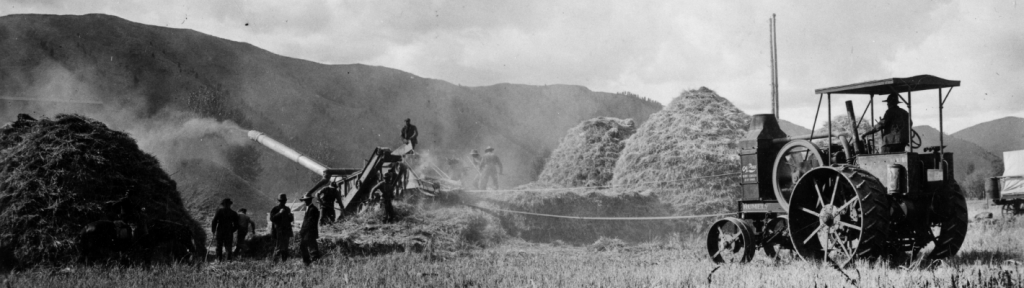
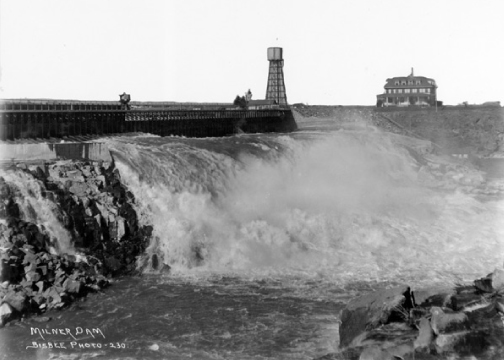
- 73-221-162, Bisbee Dam, Milner Dam, Idaho State Archives
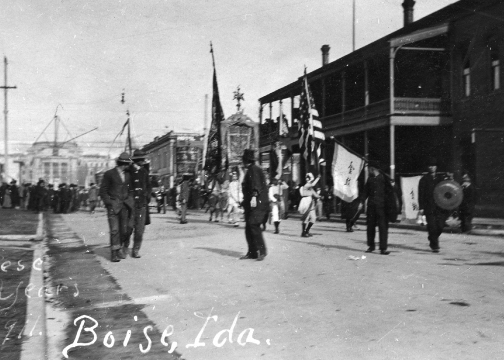
- 1034a Boise Chinese New Year Parade, Idaho State Archives
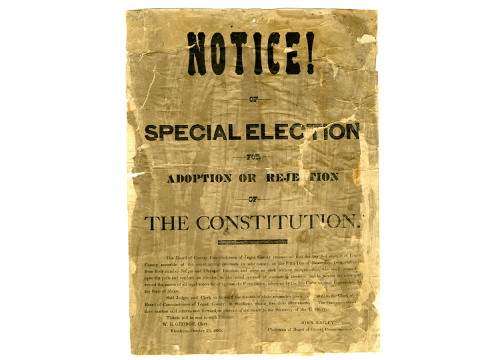
- AR1, Box 46A, Notice Constitution Election, Idaho State Archives
- P2022-11-6, William S. Claggett, Idaho State Archives
- Library of Congress, Roosevelt Signs Social Security Bill, photograph, 1935, New York World-Telegram and the Sun Newspaper Photograph Collection, Prints and Photographs Division, Library of Congress, Washington, DC, https://www.loc.gov/pictures/item/00649636.
Educator Open House by Boise Museum Association
EVENT DETAIL-
00
days
-
00
hours
-
00
minutes
-
00
seconds